Media Summary: Seismic propagation may exhibit very complex physics, especially on land where elastic and attenuation are dominating effects. Unresolved velocity anomalies in the near surface degrade deeper imaging. As a consequence, great care needs to be taken to ... In this presentation, Naeini discusses a quantitative approach to do well tie and to QC the outcome. This covers the basic ...

Eage E Lecture Viscoelastic Full - Detailed Analysis & Overview

Seismic propagation may exhibit very complex physics, especially on land where elastic and attenuation are dominating effects. Unresolved velocity anomalies in the near surface degrade deeper imaging. As a consequence, great care needs to be taken to ... In this presentation, Naeini discusses a quantitative approach to do well tie and to QC the outcome. This covers the basic ... Current solutions to receiver deghosting of marine seismic data generally involve making complementary measurements of the ... Building an accurate image of the subsurface in complex geological settings remains a serious issue for geophysicists. If the first ... It is relatively well known that migration stretches the waveforms of dipping reflections. It is less well known how this impacts ...

In recent years, elastic inversion and quantitative interpretation of pre-stack seismic data have become standard procedures in the ... Wide-azimuth long-offset OBC/OBN surveys provide a suitable framework to perform computationally-efficient 3D ...

Photo Gallery

EAGE E-lecture: Viscoelastic Full Waveform Inversion, by Gabriel Fabien-Ouellet
EAGE E-Lecture: Resolving Near-Surface Velocity Anomalies in Marine Data by Ian F. Jones
EAGE E-Lecture: Well Tie: Principles & New Advancements for Broadband Seismic Data, by Ehsan Naeini
EAGE E-Lecture: Wave Equation Receiver Deghosting by Craig Beasley
EAGE E-Lecture: Reverse Time Migration: How Does It Work, When To Use It by Etienne Robein
EAGE Student E-Lecture: A Tutorial on Gassmann’s Fluid Substitutions, by Pierre-Olivier Lys
EAGE E-Lecture: Maximising the Benefits of Full Waveform Inversion by Fabio Mancini
EAGE E-Lecture: Structural Dip, Migration and Quantitative Interpretation by Ehsan Z. Naeini
EAGE E-Lecture: An Introduction to Migration without a Single Equation by Claudio Strobbia
EAGE E-Lecture: Pseudo-Elastic Impedance by Per Avseth
EAGE E-Lecture: Data-Driven Green's Function Retrieval From Reflection Data by Kees Wapenaar
EAGE E-Lecture: Shooting over the Spread by Vetle Vinje
View Detailed Profile
EAGE E-lecture: Viscoelastic Full Waveform Inversion, by Gabriel Fabien-Ouellet

EAGE E-lecture: Viscoelastic Full Waveform Inversion, by Gabriel Fabien-Ouellet

Seismic propagation may exhibit very complex physics, especially on land where elastic and attenuation are dominating effects.

EAGE E-Lecture: Resolving Near-Surface Velocity Anomalies in Marine Data by Ian F. Jones

EAGE E-Lecture: Resolving Near-Surface Velocity Anomalies in Marine Data by Ian F. Jones

Unresolved velocity anomalies in the near surface degrade deeper imaging. As a consequence, great care needs to be taken to ...

EAGE E-Lecture: Well Tie: Principles & New Advancements for Broadband Seismic Data, by Ehsan Naeini

EAGE E-Lecture: Well Tie: Principles & New Advancements for Broadband Seismic Data, by Ehsan Naeini

In this presentation, Naeini discusses a quantitative approach to do well tie and to QC the outcome. This covers the basic ...

EAGE E-Lecture: Wave Equation Receiver Deghosting by Craig Beasley

EAGE E-Lecture: Wave Equation Receiver Deghosting by Craig Beasley

Current solutions to receiver deghosting of marine seismic data generally involve making complementary measurements of the ...

EAGE E-Lecture: Reverse Time Migration: How Does It Work, When To Use It by Etienne Robein

EAGE E-Lecture: Reverse Time Migration: How Does It Work, When To Use It by Etienne Robein

Building an accurate image of the subsurface in complex geological settings remains a serious issue for geophysicists. If the first ...

EAGE Student E-Lecture: A Tutorial on Gassmann’s Fluid Substitutions, by Pierre-Olivier Lys

EAGE Student E-Lecture: A Tutorial on Gassmann’s Fluid Substitutions, by Pierre-Olivier Lys

EAGE

EAGE E-Lecture: Maximising the Benefits of Full Waveform Inversion by Fabio Mancini

EAGE E-Lecture: Maximising the Benefits of Full Waveform Inversion by Fabio Mancini

Full

EAGE E-Lecture: Structural Dip, Migration and Quantitative Interpretation by Ehsan Z. Naeini

EAGE E-Lecture: Structural Dip, Migration and Quantitative Interpretation by Ehsan Z. Naeini

It is relatively well known that migration stretches the waveforms of dipping reflections. It is less well known how this impacts ...

EAGE E-Lecture: An Introduction to Migration without a Single Equation by Claudio Strobbia

EAGE E-Lecture: An Introduction to Migration without a Single Equation by Claudio Strobbia

This

EAGE E-Lecture: Pseudo-Elastic Impedance by Per Avseth

EAGE E-Lecture: Pseudo-Elastic Impedance by Per Avseth

In recent years, elastic inversion and quantitative interpretation of pre-stack seismic data have become standard procedures in the ...

EAGE E-Lecture: Data-Driven Green's Function Retrieval From Reflection Data by Kees Wapenaar

EAGE E-Lecture: Data-Driven Green's Function Retrieval From Reflection Data by Kees Wapenaar

This

EAGE E-Lecture: Shooting over the Spread by Vetle Vinje

EAGE E-Lecture: Shooting over the Spread by Vetle Vinje

EAGE E

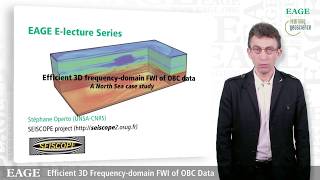
EAGE E-Lecture: Efficient 3D Frequency-Domain FWI of OBC Data By Stéphane Operto

EAGE E-Lecture: Efficient 3D Frequency-Domain FWI of OBC Data By Stéphane Operto

Wide-azimuth long-offset OBC/OBN surveys provide a suitable framework to perform computationally-efficient 3D ...