Media Summary: Well congratulations you've almost made it almost welcome to our last ... states for n qubits so mathematically speaking they live in the in the hilbert space of dimension ... are protected so the whole art of protecting information has a long history and you know one can give a series of

Iqis Lecture 8 2 Classical - Detailed Analysis & Overview

Well congratulations you've almost made it almost welcome to our last ... states for n qubits so mathematically speaking they live in the in the hilbert space of dimension ... are protected so the whole art of protecting information has a long history and you know one can give a series of (November 14, 2011) Leonard Susskind discusses the some of the basic laws and ideas of modern physics. In this Let's start with notations how do we describe a state of ... an observable will split will bisect the hilbert space in two subspaces of equal equal dimensions so you'

So let me summarize very briefly especially the last part of the ... that we can reverse the whole process and reset the aerosome space back to the code space but we'
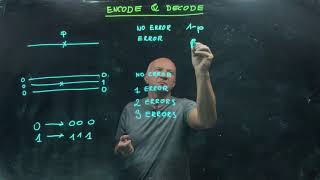
Photo Gallery

IQIS Lecture 8.2 — Classical repetition codes
IQIS Lecture 2.8 — Approximating unitaries
IQIS Lecture 8.1 — Overview of quantum error correction
IQIS Lecture 2.2 — Why qubits?
IQIS Lecture 7.8 — Concatenation of physically-admissible operations
IQIS Lecture 5.2 — Classical one-time pads
Classical Mechanics | Lecture 8
IQIS Lecture 6.8 — Simon's algorithm
IQIS Lecture 3.2 — Dimension argument for entanglement
IQIS Lecture 8.11 — Stabilizers
IQIS Lecture 7.12 — Summary: Stinespring and Kraus representations
IQIS Lecture 8.8 — Correctable errors
View Detailed Profile
IQIS Lecture 8.2 — Classical repetition codes

IQIS Lecture 8.2 — Classical repetition codes

... me consider a very simple

IQIS Lecture 2.8 — Approximating unitaries

IQIS Lecture 2.8 — Approximating unitaries

... write the expression and i'

IQIS Lecture 8.1 — Overview of quantum error correction

IQIS Lecture 8.1 — Overview of quantum error correction

Well congratulations you've almost made it almost welcome to our last

IQIS Lecture 2.2 — Why qubits?

IQIS Lecture 2.2 — Why qubits?

... states for n qubits so mathematically speaking they live in the in the hilbert space of dimension

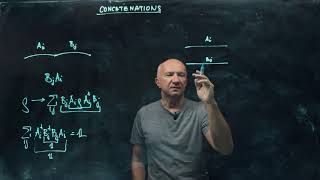
IQIS Lecture 7.8 — Concatenation of physically-admissible operations

IQIS Lecture 7.8 — Concatenation of physically-admissible operations

Composition of Quantum Operations ...

IQIS Lecture 5.2 — Classical one-time pads

IQIS Lecture 5.2 — Classical one-time pads

... are protected so the whole art of protecting information has a long history and you know one can give a series of

Classical Mechanics | Lecture 8

Classical Mechanics | Lecture 8

(November 14, 2011) Leonard Susskind discusses the some of the basic laws and ideas of modern physics. In this

IQIS Lecture 6.8 — Simon's algorithm

IQIS Lecture 6.8 — Simon's algorithm

... have one plus one is equal to

IQIS Lecture 3.2 — Dimension argument for entanglement

IQIS Lecture 3.2 — Dimension argument for entanglement

Let's start with notations how do we describe a state of

IQIS Lecture 8.11 — Stabilizers

IQIS Lecture 8.11 — Stabilizers

... an observable will split will bisect the hilbert space in two subspaces of equal equal dimensions so you'

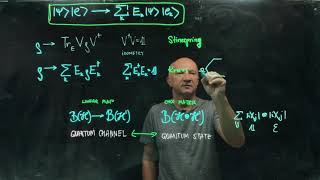
IQIS Lecture 7.12 — Summary: Stinespring and Kraus representations

IQIS Lecture 7.12 — Summary: Stinespring and Kraus representations

So let me summarize very briefly especially the last part of the

IQIS Lecture 8.8 — Correctable errors

IQIS Lecture 8.8 — Correctable errors

... that we can reverse the whole process and reset the aerosome space back to the code space but we'

IQIS Lecture 8.7 — Inverting quantum channels (revisited)

IQIS Lecture 8.7 — Inverting quantum channels (revisited)

... it we'